

Recent Cases
Permission to proceed? Derivative claim denied
Company law, Commercial disputes, Joint venture and partnership disputes, Trusts, probate and estates: contentious
Nikki Singla KC | Caspar Bartscherer
Tuesday 6 October 2026
Trusts, probate and estates: contentious, Trusts, probate and estates: non-contentiousWednesday 23 July 2025
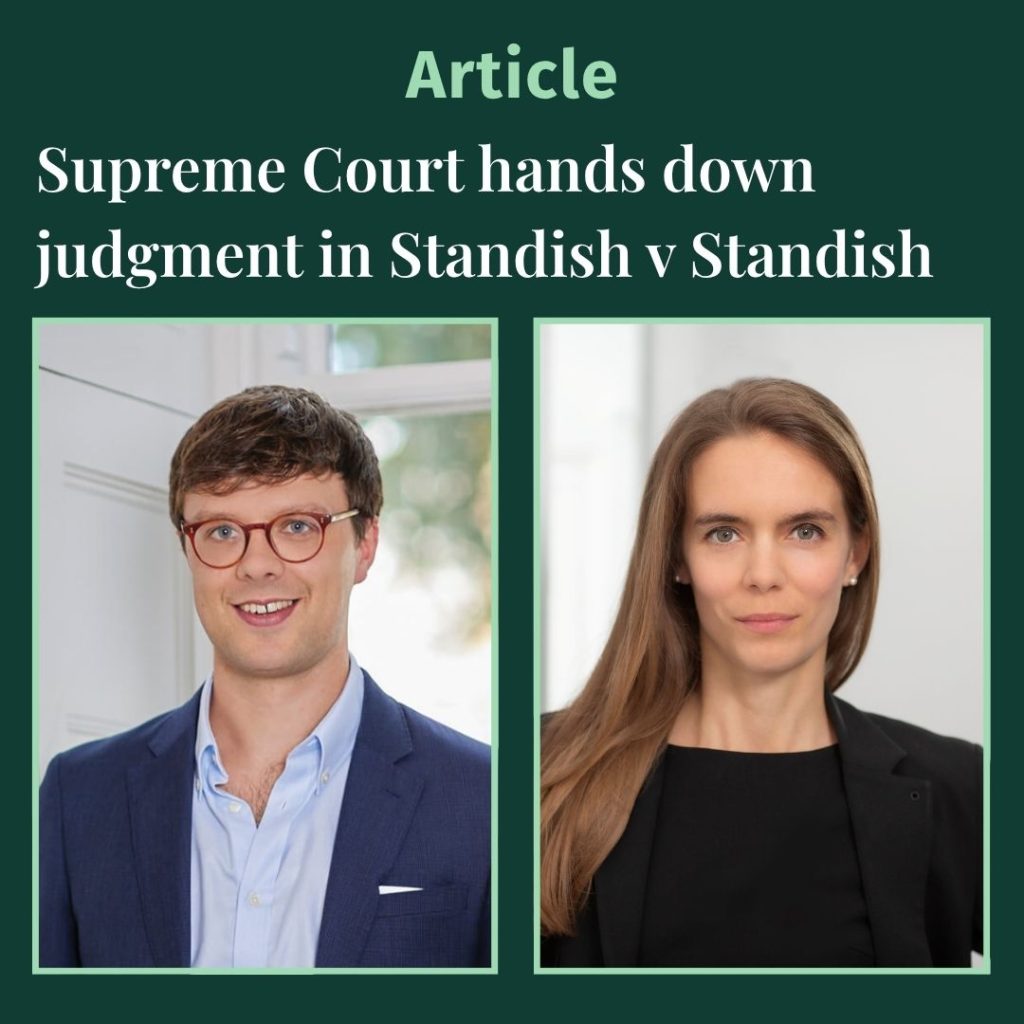
Article by Joseph Steadman and Roxane Reiser, 23rd July 2025.
To read or download this article as a PDF, please click here.
On 2 July 2025, the Supreme Court handed down judgment in Standish v Standish [2025] UKSC 26. The purpose of this article is to go beyond the family law questions considered in the judgment – the identification of “matrimonial” and “non-matrimonial” assets, and the application of the “sharing principle” to the former but not the latter – and to consider the implications for private client practitioners.
In particular, the decision highlights the need for careful thought before advising on – or entering into – transactions involving assets which might be considered to be characterised as non-matrimonial. There is a risk of inadvertently causing such assets to be “matrimonialised” and thus rendered vulnerable to sharing claims.
Matrimonial finance principles: a refresher for private client practitioners
Before turning to what was decided in Standish, it is convenient first to summarise the way that the courts approach the exercise of their powers to make financial orders following a divorce.[1]
In overview, and glossing over some important points of detail, the following principles are considered by the courts with the overall aim of achieving a fair outcome.[2]
The courts have long recognised a distinction between:
Non-matrimonial property can be invaded to satisfy the “needs principle” and/or the “compensation principle” but – unlike matrimonial property – is not normally considered available to meet a claim based on the “sharing principle”. However, prior to Standish:
The stage was thus set for a case which addressed those issues. Enter Standish.
The decision in Standish
It had been almost 20 years since our highest court (then the House of Lords) last considered the general approach to the division of assets following a divorce.[5] That alone would have made the Supreme Court’s decision noteworthy. But it also upheld the largest ever reduction in a financial remedy award (£20m) in favour of the husband.
The essential question before the Supreme Court, as identified in paragraph [6], was:
How does the sharing principle apply where, a relatively short time before the divorce, the husband made a transfer of assets (the “2017 Assets”), worth some £80m, to the wife for the purpose of setting up trusts to negate inheritance tax and where, at the date of the divorce, the wife had not set up the trusts and retains the assets?
The bulk of the 2017 assets had been generated by the husband before the marriage. They were transferred by the husband to the wife in order to prevent a potential future inheritance tax liability from arising in respect of his estate if he died while deemed domiciled in the UK (she herself was non-UK domiciled). It was intended that the wife would in due course settle the assets upon discretionary trusts for the benefit of the children of the marriage.
At first instance Moor J found that the transfer to the wife resulted in the assets becoming matrimonial property. The husband had to give up all interest in the assets for the tax saving scheme to work. In those circumstances, the only possibility was that they became matrimonial property and thus that the sharing principle applied. However, this did not mean that the funds were to be divided equally. Moor J concluded that the appropriate division should be 40% to Mrs Standish and 60% to Mr Standish—a departure from equality to account for Mr Standish’s pre-marital endeavour.
In a unanimous decision, the Court of Appeal allowed Mr Standish’s appeal, finding that the transfer did not “matrimonialise” the non-matrimonial portion of the 2017 assets. Moylan LJ (with whom King LJ and Philips LJ agreed) stated that the source of an asset – and not title – is the critical factor. To hold otherwise would be deeply discriminatory. Ownership was not a good guide to fairness. Mrs Standish’s award was accordingly reduced from £45m to £25m. However, Moylan LJ emphasised in paragraphs [162] to [163] that the concept of matrimonialisation should be applied narrowly so as not to undermine the clarity of the sharing principle.
The Supreme Court unanimously upheld the Court of Appeal’s decision. Lord Burrows and Lord Stephens (with whom the other justices agreed):
Applying those principles to the facts in Standish, Lord Burrows and Lord Stephens found at [56] that the transfer to the wife had not matrimonialised the 2017 assets (emphasis added):
In relation to a scheme designed to save tax under which one spouse transfers an asset to the other spouse, the parties’ dealing with the asset, irrespective of the time period involved, do not normally show that the asset is being treated as shared between them. Rather the intention is simply to save tax.
Thus, further “compelling evidence” would be required before the parties would be regarded as treating the transferred assets as shared between them.
Clarity or complexity?
The decision is being hailed by many as providing much needed clarity on the application of the sharing principle. That view is overstated for three reasons:
While it will be reassuring to many private client and tax advisors that capital transfers between spouses will not, without more, result in the relevant assets becoming matrimonialised – and thus presumptively shared equally upon divorce – the spectre of matrimonialisation remains.
A tax saving transaction between spouses may be driven by several reasons, some of which could be regarded as consistent with a sharing intent. A sharing intent could also be inferred from the way in which the assets is dealt with after the tax saving transaction has taken place (e.g. where the relevant asset becomes part of the marital economy).
Moreover, the risk of matrimonialisation is relevant not just to transfer between spouses, but also (a) transfers from third parties to one spouse (eg. an advance inheritance or “Bank of Mum and Dad” contribution) and (b) transfers into trusts or other structures.
Some fear that the decision may lead HMRC to look more closely at capital transfers between spouses. They point to the apparent contradiction between a statement to HMRC that an asset has been gifted to an individual’s spouse and the conclusion that said asset remains non-matrimonial and therefore immune to the application of the sharing principle upon divorce. The contradiction can readily be explained by the fact that the court exercising its discretion under section 25 of the Matrimonial Causes Act 1973 is not guided by title but by fairness. In other words, the fact that a spouse may arguably be entitled upon divorce to a sharing claim in respect of a particular asset is separate from the question of who owns that asset legally and/or beneficially. Further any entitlement to a particular asset only crystalises upon divorce once a final financial remedy order has been made. Any renewed scrutiny of inter-spousal transfers by HMRC on account of Standish alone therefore appears speculative.
Claims of matrimonialisation post-Standish
What consequences may flow from the Supreme Court’s bright line distinction between non-matrimonial property and matrimonial property?
One possibility – since the “sharing principle” now unambiguously does not apply – may be a renewed focus on the “needs principle” and the “compensation principle” in order to gain access to the non-matrimonial property (including, for example, property held on pre-existing trusts).
Another may be fresh arguments that non-matrimonial assets – including those held in trust and other structures – have been matrimonialised based on their use or “treatment” over time for the benefit of the spouses or the family as a whole. In relation to assets held within trust or other structures, those arguments may in turn give rise to further issues. For example:
These sorts of arguments may well join the usual arsenal of claims against trust assets in matrimonial proceedings: (a) resource arguments, (b) arguments about the validity or true nature of the trust (e.g. shams, bare trusts etc) and (c) variation of nuptial settlement.
Matrimonialisation and nuptialisation
In Standish the 2017 assets were intended to be settled into discretionary trusts in Jersey for the benefit of the parties’ two children. The husband’s evidence was that he had received advice that he could be added as a beneficiary of the trusts after they had been established but not at inception. This assertion was received sceptically by Moor J (at [61]) who stated that he did not see how the husband could be added later unless it was with the intention of misleading HMRC. Because the husband failed to call his Jersey advisers to give evidence, Moor J concluded that there was no evidence that the husband could have been a beneficiary of the trusts. The wife had been advised that she could be a discretionary beneficiary or a life tenant so long as she remained non-domiciled, however she had no appetite to return to her country of origin.
Had the trusts been established before the proceedings – and had either spouse been at least capable of benefiting from it, even by being the object of a power to add beneficiaries – the Supreme Court may well have found that the assets had been matrimonialised and were thus subject to the sharing principle.
This analysis brings to mind the controversial concept of “nuptialisation” of settlements so as to make them susceptible to variation under section 24(1)(c) of the Matrimonial Causes Act 1973.
In light of Standish, there is every possibility that these debates would be revisited if the issue came before the courts.
The future
There remain many unanswered questions following the Supreme Court’s decision. In the coming years – and perhaps decades – we can expect to see more interesting developments as the consequences of the decision are worked through, and the boundaries of matrimonialisation further charted.
Meanwhile, parties would do well to make their intentions explicit – whether by way of pre-/post-nuptial agreements or carefully drafted trust deeds – before entering into potentially matrimonialising transactions. Any provision made for the spouses, including any potential benefit as the object of a power to add beneficiaries, may make the assets vulnerable to the sharing principle.
[1] The relevant principles are not limited to divorce. They also apply where a marriage has been annulled or there has been a judicial separation, and where there has been a dissolution, nullity or judicial separation in respect of a civil partnership. See paragraph [2] of the Supreme Court’s judgment.
[2] See paragraphs [4] to [7] of the Supreme Court’s judgment.
[3] The Court of Appeal in Charman v Charman (No 4) [2007] EWCA Civ 503 expressly rejected such a rule, instead stating that the sharing principle applied to all the parties’ property but that “there is likely to be a better reason for departure from equality” in respect of non-matrimonial property.
[4] See footnote 7, below.
[5] The two leading cases, as summarised in paragraphs [30] to [45] of the Supreme Court’s judgment, were White v White [2001] 1 AC 596 and Miller v Miller; McFarlane v McFarlane [2006] 2 AC 618.
[6] Mostyn J had memorably said that a case where it would be appropriate to apply the sharing principle to non-matrimonial property “would be as rare as a white leopard”: JL v SL (No 2) [2015] EHC 360 (Fam) at [22].
[7] The leading examination of matrimonialisation before Standish was in K v L [2011] EWCA Civ 550 at [18] by Wilson LJ as he then was. Three categories of matrimionialisation were identified, namely (a) where over time matrimonial property of such value has been acquired as to diminish the significance of any non-matrimonial contribution (b) where non-matrimonial property and matrimonial property have become mingled and where either (i) the contributor of non-matrimonial property can be said to have accepted that the asset would be shared or (ii) distinguishing between non-matrimonial and matrimonial property has become evidentially too difficult and (c) where non-matrimonial property is used to purchase a matrimonial home. The Supreme Court in Standish stated at [52] that these categories were not expressed to be exclusive.
[8] This point is touched upon in Lewin on Trusts at [51-032].
For more information:
The views expressed in this material are those of the individual author(s) and do not necessarily reflect the views of Wilberforce Chambers or its members. This material is provided free of charge by Wilberforce Chambers for general information only and is not intended to provide legal advice. No responsibility for any consequences of relying on this as legal advice is assumed by the author or the publisher; if you are not a solicitor, you are strongly advised to obtain specific advice from a lawyer. The contents of this material must not be reproduced without the consent of the author.
People to view:
Recent Cases
Company law, Commercial disputes, Joint venture and partnership disputes, Trusts, probate and estates: contentious
Nikki Singla KC | Caspar Bartscherer
Tuesday 6 October 2026

External Conferences
7 - 9 October 2026
CVK Park Bosphorus Hotel Istanbul, Turkey
Speakers:
Gilead Cooper KC | Clare Stanley KC | Jonathan Davey KC | Tom Roscoe | Michael Ashdown | Tommie Drury

Events / Webinars
Monday 18 January 2027 | 9am - 5.45pm followed by drinks and dinner
InterContinental London, Park Lane

External Conferences
Wednesday 11 November 2026
Macfarlanes, 20 Cursitor St
Free for ConTrA members
Speakers:
Simon Atkinson